Letter from May 20, 1945
May 20, 1945
Dear Buster:
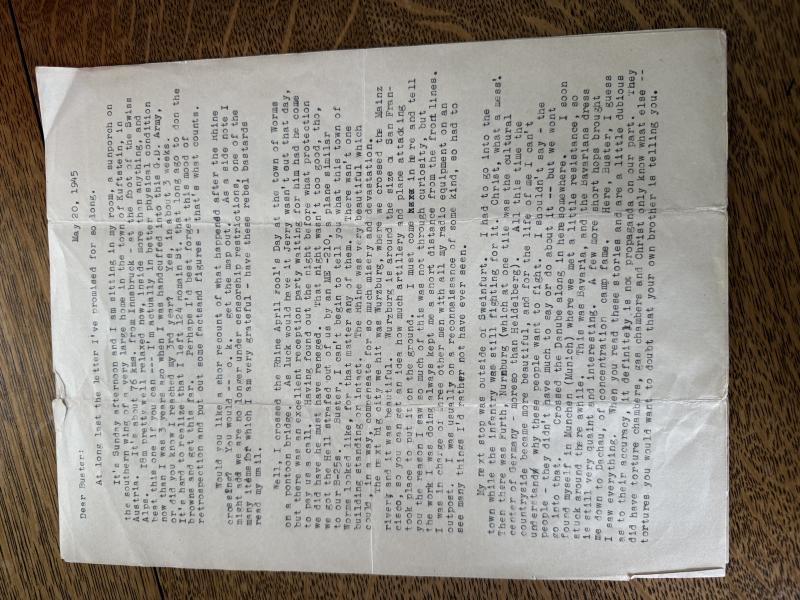
At long last the letter I've promised for so long.
It's Sunday afternoon and I am sitting in my room, a sunporch on the southern wing of a very large home in the town of Kufstein, in Austria. It's about 76 kms. from Innsbruck — at the foot of the Swiss Alps. I'm pretty well relaxed now, like more than anything; and you know this one if you ever tried. I'm actually in better physical condition now than I was 3 years ago when I was handcuffed into this G.I. Army, or did you know I reached my 3rd year? Yes, in about six weeks. It's hard to realize that I left 124 Roman St. three years ago to come over here and get this far. Perhaps I'd best forget the mileage and retrogress and pull out some creased and figured maps.
Would you like a short account of what happened after the Rhine crossing? You would — so here's the map out. As a matter of fact, and as we are no longer under censorship restrictions, one of the many things for which I am very grateful we have these rebel bastards read my mail.
Well, I crossed the Rhine April Fool's Day at the town of Worms on a pontoon bridge. As luck would have it Jerry wasn't out that day, but there was an excellent reception party waiting for him that had to pay us a call. Having found out the night before what the opposition was like here we must have merged. "That night wasn't too good, then we got hit — so the next morning on ME–201s, then out with the big E–25s." Buster, I can't begin to tell you what that town of Worms looked like, for that matter everything. There wasn't one building standing or intact. The Rhine was very beautiful which of course it always is, but too much misery and devastation.
My next stop was the town of Mainz, somewhere where we hit the Mainz River, and it was fairly intact. Wurzburg is another, and the size of San Francisco, with its fine old building — and finally my plane tracking took place to put it on the ground. I must come back in here and tell you the reason I am over other things was not through curiosity, but the work I was doing always kept me a short distance from the front lines. I was in charge of one of our stations with all my radio equipment on an outpost. I was usually on a reconnaissance of some kind, so had to see many things I'd rather not have ever seen.
My next stop was outside of Schweinfurt. I had to go into the town while the infantry was still fighting for it. Christ, what a mess! Then there was Fürth, Nurnburg (which at one time was the cultural center of Germany — more so than Heidelberg). All the time the countryside became more beautiful, and for the life of me I can't understand why these people want to fight. I shouldn't say "the people" — they didn't have much to say or do about it — but we went on into that. I crossed the Danube along in here somewhere. I soon found myself in Munchen (Munich) where we met a little resistance, so stuck around there awhile. This was Bavaria, and the Bavarians dress is still very quaint and interesting. A few more short hops brought me down to Dachau, the concentration camp area. Here, Buster, I guess I saw everything. When you read these stories and are a little dubious as to their accuracy, or that they are definitely not propaganda on our part. They did have torture chambers, gas chambers and Christ only knows what else — tortures you would want to doubt that your own brother is telling you.
Page 2
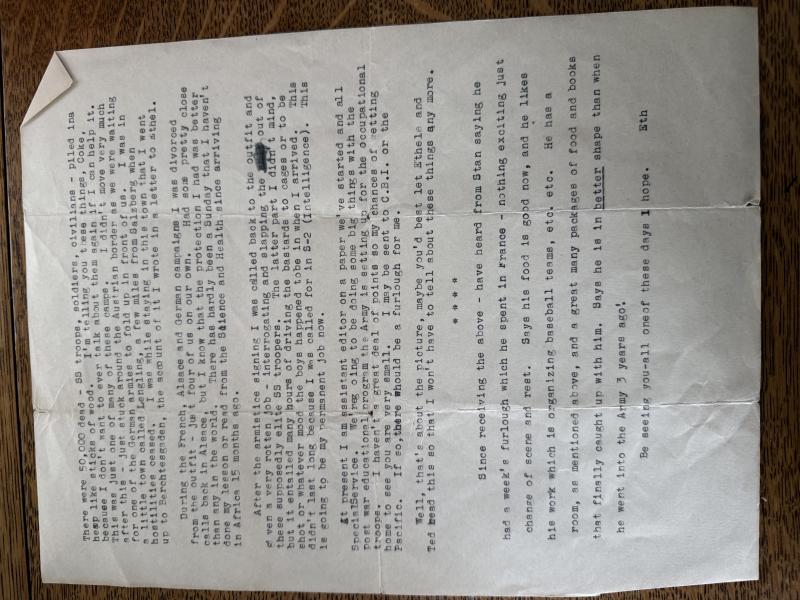
There were 50,000 dead — SS troops, soldiers, civilians — piled in a heap like sticks of wood. I'm telling you these things, Coke, because I don't want to ever talk about them again if I can help it. This was just one of many of these camps. I didn't move very much after that. Just extended around the Austrian border as we were waiting for one of the German armies to fold up in front of us. I was in a little town called Lenzing, a few miles from Salzberg when hostilities ceased. I was while staying in this town that I went up to Berchtesgaden, the account of it I wrote in a letter to Ethel.
During the French, Alsace and German campaigns I was divorced from the outfit. Just four of us on our own. Had some pretty close calls back in Alsace, but I know that the protection I had was better than any in the world. There has hardly been a Sunday that I haven't done my lesson or read from the Science and Health since arriving in Africa 15 months ago.
After the armistice signing I was called back to the outfit and sent on every hot job — interrogating and slapping the you-know-what out of these supposedly SS troopers. The latter part I didn't mind, but it entailed many hours of driving the bastards to cages or to be shot or whatever the boys happened to be when I arrived. This didn't last long because I was called for in S-2 (Intelligence). This is going to be my permanent job now.
At present I am assistant editor on a paper we've started and all Special Service. We're going to be doing some big things with the post war educational program the Army is setting up for the occupational troops. If everything breaks right we may have a chance of getting home to see you this year. I want nothing more than to be in the office with you all. Maybe you've heard that I may be in the C.B.I. or the Pacific. Beyond that I don't know.
Well, that's about the picture, maybe you'd best let Ethel and Ted read this so that I won't have to tell about these things any more.
* * * * *
Since receiving the above — have heard from Stan saying he had a week's furlough which he spent in France — nothing exciting just change of scene and rest. Says his food is good now, and he likes his work which is organizing baseball teams, etc. etc. He has a room, as mentioned above, and a great many packages of food and books that finally caught up with him. Says he is in better shape than when he went into the Army 3 years ago!
Be seeing you-all one of these days I hope.
Eth